Wednesday, November 2, 2016

What am I voting for on November 8?

We keep reading and hearing about emails, Russian spy efforts, and pending litigation. I thought I would take a moment and share with you what I am voting FOR on November 8, rather than enumerating all the reasons I am voting AGAINST Donald Trump.

1) I am voting for workers rights and the right to unionize.
Right now, Philadelphia and the surrounding region is immobilized by a transit strike. Harvard food service workers have just ended their strike. I'm still working without a contract, along with all of my colleagues. Hillary Clinton and the Democratic party are committed to the continued right to unionize, to workers' rights, and to supporting workers during this massive technology upheaval that we are facing. Kim Pearson constantly reminds us, wisely, that tomorrow's economy will not look like today's or yesterday's.


Hillary Clinton understands this in a way that Donald Trump, and the Republican Party, does not. The GOP opposes unionization and continues to support the industries of the past, particularly fossil fuels. That said, I know that the Obama administration just signed off on additional pipelines. Nonetheless, I am much more confident that progressives can exert moral authority in a Democratically controlled Senate and in a HRC administration than in a Trump one.

2) I am voting for national parks.

The Republican platform explicitly targets public ownership and seeks to privatize national parks. The fact that the GOP seeks to undo one of the greatest achievements of one of the greatest American presidents nauseates and angers me. Roosevelt is very angry somewhere. I hope his "big stick" has a cosmic dimension.

3) I am voting for my daughters' right to their bodies and their own healthcare decisions.

We know how Donald Trump feels about women's bodies. He feels that men are entitled to them; that they are objects; that women do not have the same status as sentient subjects as he does. We know that he sees himself as a person in relationship to a number of objects. African-Americans are "his African Americans." He can "grab" what he wants to. When he "sees beautiful" he can't stop himself. I don't need to bother to link any of these, you already know them.

But I am more concerned about the Republican platform and a potential "President Pence." The Republican platform continues to advocate for the most dangerous elements of the patriarchy. It denies a woman's right to choose her reproductive future; it denies the legitimacy of same sex marriage; it denies a woman's existence as an autonomous being outside of family structures. And Mike Pence has presented himself to the Republican base as a tireless advocate for a future that bears altogether too much relationship to Margaret Atwood's "Gilead"--as a theocrat rather than as a Republican.

My daughters can not yet vote, and I lost my mother and my aunt last year, so they can not vote. So I am voting for them. I hope four other people help me out so that we aren't down three when it comes to women's rights.

These three reasons are why I am voting for Hillary Clinton on Tuesday.

Friday, October 14, 2016

Why the best presidential candidate for American men is a woman.

We all certainly expected Hillary Clinton's nomination for president to inspire a discussion of gender, but I'm guessing few of us would have expected us to wind up discussing the nature of masculinity with the intensity that we have in recent days. While Rush Limbaugh suggests that liberals have taken all the fun out of sex by focusing on consent, Mike Pence intones lovingly about Donald Trump's "broad-shouldered leadership." When Marco Rubio gestured obliquely to the significance of Donald Trump's baby hands, I'm sure few of us expected Dr. Oz would affirm Trump's extraordinary testosterone levels. Although the model of Republican masculinity, Theodore Roosevelt, once said, "Speak softly and carry a big stick," Donald Trump apparently suggests men should speak loudly and incoherently and swing a big dick.

So while Trump's supporters strain the bounds of propriety for broadcast television with their obscene t-shirts, salivating through their broken and missing teeth that Trump is exactly the kind of man they want to be, let me suggest something different. Hillary Clinton's presidency is the best thing that could happen to American men, and, despite their protestations to the contrary, the responsibility for the decline of American masculinity lies squarely on the narrow shoulders of the Republican party.

Although the Bush administration provided ample opportunities for American men to bleed and die, suffer and kill on the battlefield, and thereby exercise one expression of traditional American masculinity, it also gutted the construction industry, which employs vastly more men than women as laborers. But men have been losing more jobs than women in every recession since the 1980s, all of which have been presided over by Republican presidents.  Mark Perry even called the Great Recession the "mancession" in his Congressional testimony. And the jobs where men go out, get dirty, and build things, have not returned. 

Perhaps this has also been part of Trump's appeal. In his continual repetition that he is a "builder" a "job-creator," he invokes the hard-hatted construction site, full of bawdy catcalling and expressions of brotherhood. Yet the other site traditionally associated with laboring men--the union hall--is another object of Trump's disdain. He has a long track record of hiring illegal, un-unionized immigrant laborers. In this way, he is right in line with the Republican mainstream. Their party platform praises the "right to work," which could be rephrased as the "right to be exploited."

So Hillary Clinton's promise to rejuvenate our infrastructure, to promote organized labor, is a promise to rescue American manhood from Trump's and the RNC's toxic interpretation of it. Take a look at her platform page for "fixing America's infrastructure" if you have any doubt. We see a line of proud, hairy-faced men, but only the white man is in focus. Her message is clear--if American masculinity is to survive with its positive associations intact -- strength, honor, virtue, pride, reliability, creativity -- American men have one choice: to vote for a woman.


Wednesday, July 20, 2011

Resolution

So I promised myself that I would write a little bit every day on this blog. Today I have all sorts of things coursing through my mind: a conference abstract that I need to write, a research project I need to finish, but I keep getting distracted. While I keep telling myself that I'm not as in love with my cellphone as the gum-chewing 7th graders whose essays I've been reading looking for features of African American English, I keep finding myself drawn back to it and the feed it gives from the hive. For example, I've just spent five minutes reading (and chiming in from the peanut gallery) on a conversation on Facebook between two friends with diametrically opposed opinions that don't seem open to any compromise position. One participant presents an argument, "American tax rates are too low to be sustainable in a country where infrastructure and education are necessary for prosperity," while the other presents the counter-argument, "Taxes are theft."

So that got me thinking: what countries have no income taxation? Well, Brunei has no taxes. Alas, few of us want to live in Borneo. Andorra has no income taxes, but even I don't like sheep that much. Their major sources of revenue seem to be tourism and some exports. They have no military-industrial complex, are geographically small, and seem to be based largely around catering to people who want to hide their money from the places in which they make it.

When "objectivists" and "libertarians" talk about low-taxation countries and systems, do they even have a model that they're looking toward? I can think of some, but none of them are good. Feudal Europe had few personal income taxes, but no industrial base. Oh, and yeah, the overlords weren't that great either.

Tuesday, July 19, 2011

Anything worth blogging about?

Another 13 months has gone by without my writing anything in this blog. I've done a little online writing for our Sigma Tau Delta blog, "How many English majors does it take...", but I haven't written anything of my own for quite a while. And after a very interesting book group meeting last week about "writers' notebooks," I decided that I would try my hand to see if I could manage a year's-worth of online writing to try to get me inspired for all the other writing I have to do. I don't know if there are any world traditions that start their years at July 19, but what's wrong with making a mid-year resolution?

Saturday, March 20, 2010

My own bad poetry...

I've been at the Sigma Tau Delta convention in St. Louis this week/week-end, and I've listened to lots and lots of fabulous student papers, and amazing writers, but I've been inspired by one paper to write a  poem myself. I'm sure it stinks to high heaven, because I'm a linguist, not a poet.

Twenty-seven volumes line the shelves,
covered in dust ripe with mold, mildewed in their neglect
redolent of the sweat of Scotsmen, Londoners, and colonials.
Once, James, Frederick, and Ronald argued that dwarves
mined out the soil, while the 
dwarfs labored to bejewel 
Snow White's crystalline coffin.
Twenty-seven volumes line the shelves,
awaiting undergraduate violence
perpetrated with simple-minded fingers
mining their onionskin pages,
scratching at pieces and parts, erasing histories,
flattening with timelines with over-painted or dirtied
fingernails; rhetorical blowtorches burn away
millennia of etymons, scorch the earth
beneath the feet of Saxons,
Romans, and Iberians. Oh, alas, how I sorrow for thee, 
misused omnibus of transcendent words. 

Friday, January 1, 2010

Wonderful New Book about Usage and Grammar


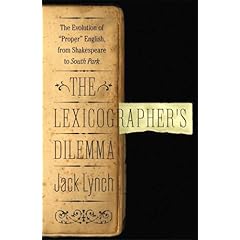
I just read a review of Jack Lynch's Lexicographer's Dilemma in the New York Times. Anyone familiar with things Johnsonian or with things 18th century has long known of Lynch through his fabulous website and his other important contributions to the field. I'm eager to read his book and figure out how much he's covered what I'd hoped to write about 18th century grammars.