Tuesday, June 23, 2020

Reading Monuments


In the past few weeks, we have read and heard a number of responses to monuments to Confederate leaders, Conquistadors, and other historical figures who have exploited and oppressed Black and indigenous people. Although these monuments are physical objects, they still may be read as texts, as physical instantiations of narratives, so literary critics have insight to offer on their meanings. Literary critics and theorists can examine the conflict over monuments as an example of what happens when two communities of readers project the expectations of different genres onto a single text.

In many ways, readers of monuments—those who uncritically defend them as evidence of national "history" and "heritage" and those who object to them as physical reminders that Black and indigenous lives do not matter in the United States—are like the readers of the epic and the novel that Mikhail Bakhtin describes in his essay, "Epic and the Novel." Those who wish to preserve the monuments think of them as "epic objects" in Bahktin's terms. Monuments are represenative of "national tradition" and "not personal experience" and an "absolute epic distance separates" them from contemporary life (13).  The supportive viewer of the monuments sees them as "speaking about a past that is to him inaccessible," and sees them with the "reverent ppoint of view of a descendant" (13). 

Despite contemporary claims that monuments do nothing more than "honor Confederate soldiers who are buried in unmarked graves all around the South" (Frank Powell, June 16, 2020, Spring Hope Enterprise & the Bailey News), those who erected the monuments sought to memorialize the "lost cause" of the Confederacy. Over and over again in news accounts of organizing efforts, we can read an effort to memorialize not only the soldiers, but the Confederate period. In an account of the Confederate Monument organizing efforts in 1888, one "recording secretary" of the association exclaims, "How unfortunate it would be should one single name of a soldier who died for our lost cause be omitted from this roll." 

In the account of the Orangeburg, South Carolina, monument, the newspaper reports that the monument was "erected by our noble women to commemorate, for all time, the patriotism and grand deeds of those dear departed heroes who gave up their lives in the grand struggle of the Confederate War" (11 October 1893, Times and Democrat). At the same time Confederate monuments rose around South Carolina, white South Carolinians were bemoaning their state, and calling for military rule in order to avoid "Negro Domination." Senator John McLaurin (07 Dec 1898, The Manning Times) made his point of view completely transparent: according to McLaurin: "In looking for the solution of these race evils," such as an insistence on the building of railway infrastructure and educational institutions for Black citizens, "we say at the outset that it calls for the same solution—that of white supremacy—that has followed throughout the world's history. The superiority of the white, the inferiority of the black, is a principle recognized by sociologists, which no ...sentimental utterance can obscure. It has been exhibited in all ages, and the instances which Egypt gave in early days are today repeated in the advance of Anglo-Saxon civilization under the baners of the Sirdar and the driving back of the black hordes at Khartoum." Even in his own time, McLaurin conjures the epic distance of ancient history in his justification for white supremacy.

So we may say that those who wish to see the monuments remain as memorials to Confederate dead are naive in their belief that these are neutral memorials, but they also claim that they represent a "history" so far distant from us that it no longer touches our present. Those who wish for the monuments to come down read them in the way Bakhtin suggests we read the novel: in the novel, the artistic object "acquires a relationship—in one form or another, to one degree or another—to the ongoing event of current life in which we, the author and readers, are intimately participating. This creates the radically new zone for structuring images in the novel, a zone of maximally close contact between the represented object and contemporary reality in all its inconclusiveness—and consequently a similarly close contact between the object and the future" (31). We see, over and over again, reports of the pain that these monuments cause those who interact with them. The editors of the Wilmington News Journal characterize this interaction in these novelistic terms: "For modern African American citizens to have to walk in the shadow of the man [Robert E. Lee] who led the crusade to preserve slavery is a daily slap in the face—indeed, to any American supportive of racial justice amid recent reminders of how elusive it is" (June 16, 2020). 

These monuments are, themselves, characters in the unfolding novel of American life.

Bakhtin, M. M. (Mikhail Mikhaĭlovich), 1895-1975. The Dialogic Imagination: Four Essays. University of Texas Press, 1981.

Tuesday, November 13, 2018

Because I am involved in mankind...

No man is an island, entire of itself; every man is a piece of the continent, a part of the main. If a clod be washed away by the sea, Europe is the less, as well as if a promontory were, as well as if a manor of thy friend's or of thine own were: any man's death diminishes me, because I am involved in mankind, and therefore never send to know for whom the bells tolls; it tolls for thee. Neither can we call this a begging of misery, or a borrowing of misery, as though we were not miserable enough of ourselves, but must fetch in more from the next house, in taking upon us the misery of our neighbours. Truly it were an excusable covetousness if we did, for affliction is a treasure, and scarce any man hath enough of it.
--John Donne,  Meditation XVII from Devotions upon Emergent Occasions

This semester I'm teaching a seminar on John Donne. My students and I are reading a significant selection of his poetry and prose (from the inadequate Modern Library edition), so we have spent the fall with the lusty young Donne of the "Songs and Sonets," the self-righteous Donne of the "Satyrs," and the grieving Donne of the "Epicedes and Obsequies." Today we encountered the sick Donne of the Devotions.

As I was re-reading to prepare for class, the famous passage from Meditation XVII took on new resonance, especially in light of the commemoration of the 100th anniversary of the Armistice ending World War I and the massing of troops at the US border immediately before the election to "harden the border" before the arrival of refugees from South America. 

I realized that this Donne is not just the sick Donne, or the pious Donne; it is the ethical and empathetic Donne, who sees himself "involved in mankind," who recognizes himself in his fellow human beings. 

And that led me to contemplate, as I do every morning, what seems to have gone wrong in our society--we have failed to be "involved in mankind," to recognize ourselves in others. We see it in our language describing the dead soldiers of World War I or the refugees on their desparate migration northward. Today, the Los Angeles Times reports that Customs and Border Patrol plans “to install and pre-position port hardening infrastructure equipment in preparation for the migrant caravan,” at the San Ysidro port of entry near San Diego. 

A collocates search on the NOW Corpus suggests just how "dehumanized" the word "caravan" is. Among the top 500 collocates, we see words suggesting national identity (Honduran, Guatemalan, Mexican) and words suggesting political status (asylum-seekers, migrant), but not one word that focuses on the shared humanity of the migrants (men, women, children). While we can't rely on collocation patterns to reveal exactly what people believe, we can rely on them to suggest speech patterns across large text sets. 

When we talk about the people migrating toward the US border with Mexico, we don't talk about them as people. I think that John Donne, across the centuries, encourages us to become "involved in mankind" and take "upon us the misery of our neighbours." 

Tuesday, October 30, 2018

On Globalism


globalism, n.
Pronunciation:  Brit.        /ˈɡləʊbəlɪz(ə)m/, /ˈɡləʊbl̩ɪz(ə)m/,  U.S. /ˈɡloʊbəˌlɪz(ə)m/
Origin: Formed within English, by derivation; modelled on a French lexical item. Etymons: global adj., -ism suffix.

Etymology: < global adj. + -ism suffix, perhaps after French globalisme (1923) Compare slightly later globalist n.

  The belief, theory, or practice of adopting or pursuing a political course, economic system, etc., based on global rather than national principles; an outlook that reflects an awareness of global scale, issues, or implications; spec. the fact or process of large businesses, organizations, etc., operating and having an influence on a worldwide scale, globalization.


Other, wiser minds, like Matthew Yglesias and Rabbi Rachel Barenblat have written about the anti-Semitic connotations of the term "globalist," so I won't rehearse them here. 

My goal in this short blog post is to suggest something different: we all need to be globalists. At a moment when our planet faces unprecedented environmental devastation that we have brought on largely through extractive capitalism and its reliance on fossil fuels for the last three hundred years, we need to have a global vision. Isolationism, nationalism, and fascism won't protect us from the consequences of environmental catastrophe. Moreover, we have a responsibility to our fellow humans to alleviate the suffering that we have all contributed to. We need "an outlook that reflects an awareness of global scale." We need to recognize that many of the refugees migrating to safety around the world are refugees from climate disasters. And refusing to define them as such will not change their circumstances. 

Perhaps the best way to reject White Supremacist dog-whistles like "Globalist" is to say, "Of course we're Globalists. We live or die on the Globe. And we should choose to live--together."

Friday, October 26, 2018

Teaching with differing abilities

It's been two years since I have used this space to record my thoughts or to set myself any kind of schedule for writing. Like many people, a great deal of cognitive space has been devoted to our political landscape. You may have seen the piece about post-election PTSD among students. While I know that I've felt a great deal of despair and expended a great deal of energy as I've watched our civil institutions decay, I resist using PTSD--a medical diagnosis we should reserve to characterize disability brought on by trauma--to describe how I'm feeling.

But as a college instructor, I'm aware of the ways that I need to structure my classes and my instruction to accommodate my students differing abilities. While fifteen years ago, I had more students with hearing or vision impairments that affected my delivery of instruction, today I'm encountering students who have attentional and executive function differences, sometimes brought on by persistent--and often under-treated--mental illness, particularly anxiety. Of course, the inverse question also troubles me: where have the students with hearing and vision loss gone? Why are we not seeing them in the English major?

As someone who has battled most of my life with generalized anxiety disorder and resulting depression, I contemplate how to make my struggles of use to my students. In private conversations, I've shared the short version with students who struggle, mainly so that I can convince them to seek care and to help remove the stigma against mental illness. I don't know, however, how to bring insights from my own struggle into explicit  consideration in the classroom. In the coming days, I'm going to be thinking about this, largely because I am considering John Donne's struggle with depression in his poetry and prose.

Thursday, November 10, 2016

Crunching the numbers from the election

I can't talk about the election with my students in class. It's not directly relevant to my subject matter in any way that would justify it. Instead, I put these numbers up on the board:

Voting Eligible Persons in the US: 231,556,662
Registered Voters in the US: 200,081,377
Registered Voters as a percentage of eligible voters: 86%
Presidential Ballots Cast: 131,043,000
Presidential ballots cast as a percentage of eligible voters: 56%
As a percentage of registered voters: 65%
Clinton Voters: 60,122,876
Trump Voters: 59,821,874
Clinton Voters as a percentage of the registered voters in the US: 29.9%
Trump Voters as a percentage of the registered voters in the US: 29.8%
Clinton voters as a percentage of eligible voters: 25.8%
Trump voters as a percentage of eligible voters: 25.78%

That's all I put on the board. Then I said, "we have elections all the time. If you vote, make sure everyone you know is registered. Make sure everyone you know who is registered votes."

But let us put these numbers in greater context:

Clinton voters in the primaries as a percentage of eligible voters: 7.3%
Trump voters in the primaries as a percentage of eligible voters: 5.74%

If we presume that the percentage of Trump voters in the primaries (the real die-hard Trump-enthusiasts) were to remain constant over the whole population of the US (324,118,787), we would have 18,604,418. This is less than the population of Texas or Florida. It is less than the population of New York City.

Let us reframe how we talk about the violence we see unfolding in pockets across the country. It is not the fault of "half the people in the country." At worst, it is the fault of 5% of the country who suddenly think that they are 50% of the country.  And since there are 195 million white folks in this country, it's not even ten percent of that group (and I don't presume they're all white, although my guess would be they are likely "white-identified").

So here is my question: I'm seeing all sorts of media convulsions about how these folks were ignored. Perhaps what we need to ask is what middle ground do we all have once we exclude this 5% from our reckonings. For example, one of my friends from Arizona posted a link to a Christian apologist who thinks very much the same way about literature that I do. And I know that many of the Marxist critics that I know believe in objective truth (many of the same objective truths) that Christian writers do.

I'm all for building common ground between us. I want to build common ground among the 95% of us who reject bigotry rather than trying to find common ground with the 5% who sees it as their animating drive.

Wednesday, November 9, 2016

It's mo(u)rning in America...

So here is what we should do today, rather than play the victim or blame anyone (or even indulge in conspiracy theories too long): find the women in your communities who know how to get shit done. The women who run local festivals, who run after school programs, who coach softball teams, who run community gardens. Those women--we know them. We know the grandmothers who never let a child go hungry or go without a coat when it gets cold. Put a bug in their ears. Get them to a party meeting (I'm not going to miss mine the first week of December, no matter how tired or sick or overwhelmed I am by work or by my own struggles with anxiety or depression.) Convince them to run for office in your town, or your school board, or your state legislature. Contact the women already serving on your state legislatures, and support their candidacy for the House of Representatives. And in two years, work like hell to get them elected. And two years from then, elect a president who represents the best this country has to offer. And if you want to support a third party, great, but that means joining a party on the local level--going to meetings, writing checks, going door-to-door, calling strangers. And one other thing: remember that you vote every day. You vote with your attention, you vote with your money, you vote with your smiles, with your love. If you want to end racism, stop being racist. If you want to end homophobia, don't be homophobic. If you want to end classism, don't be classist. But that will take work, and it will hurt.

Thursday, November 3, 2016

Style, Humor, and Class (both sociological and LNG 201)

A student asked me this question through our electronic question and answer system, Piazza, earlier today:

This subject of "indexical meaning" is confusing me. The definition in the book is that its meaning is derived from its direct association with context. However, I am still unsure about how exactly to use it. The example of "here" in the book helps, but are there any others that may clarify more?

So I responded thusly:

I think one reason you are confused is that you just learned to talk about words like "here" differently.  In the semantics chapter, you learned that words like "here" and "there" are examples of "spatial deixis." These words point to referents that may shift depending upon the context in which they are used. Now, what the authors are talking about with the term "indexical meaning," has to do with the concept of "style," which will (I hope) be illuminated somewhat by coming conversations about language in communities in upcoming weeks.

I think sometimes that the best ways of illustrating "style" (in its sociological sense) comes from humor, because often what we think of as humorous is that which invites us to contemplate the slippages of meaning as a result of social context. When the authors say that "Style has indexical meaning," that means that "style" (features of speech associated with particular social organizations--classrooms vs. "gossip sessions" or "church language") has meaning indexed to context--not necessarily the explicit referents the words have.

Consider this skit from Saturday Night Live a week or so ago: "Black Jeopardy" with Tom Hanks:

So the skit opens with Tom Hanks (decked out in Trump-Nation gear--hat and eagle/flag t-shirt and denim as far as the eye can see) greeting the host--Darnell--by saying "How are you doing, sir." His greeting deviates considerably from the "style" of greeting we have seen from the other characters. He even uses a "catch phrase" associated with "rednecks": "Get 'er done" (popularized by the comedian known as "Larry the Cable Guy." Now his costume and his speech set us up to assume that the ideologies to which he subscribes will be radically--perhaps even dangerously--different from the two African American women on the panel.

A couple of rounds of questions go by before he answers a question, but when he does, the other participants respond very enthusiastically. Initially, they respond to his sentiments, then to his style. In answer to the question, "They say the iPhone wants your thumbprint for your protection," he says, "I don't think so. That's how they get you." In effect, the writers have suggested that both "black folks" (as characterized by this recurring segment) and white working class folks both share a suspicion of things that suggest government surveillance.

When he responds to the question from the category "Big Girls," that says "Skinny girls can do this for you," with the answer, "What is not a damn thing," he has suddenly employed a style the other characters recognize.

Now, from my perspective, this sketch sets up a very interesting idea: that working class folks from any ethnic group will have more in common than they realize. But its modeling of the concept of style is also quite compelling. When Doug reverts back to stylistic features associated with ideologies of white supremacy, the good will of the other participants evaporates. Although they give him "a pass this time" when he says "You people," they do not when he says (in response to the "final jeopardy category" "Lives that Matter"): "You know, I got a lot to say about this" (which seems to be the formulaic preface to every "all lives matter") response to the Black Lives Matter movement.

Wednesday, November 2, 2016

What am I voting for on November 8?

We keep reading and hearing about emails, Russian spy efforts, and pending litigation. I thought I would take a moment and share with you what I am voting FOR on November 8, rather than enumerating all the reasons I am voting AGAINST Donald Trump.

1) I am voting for workers rights and the right to unionize.
Right now, Philadelphia and the surrounding region is immobilized by a transit strike. Harvard food service workers have just ended their strike. I'm still working without a contract, along with all of my colleagues. Hillary Clinton and the Democratic party are committed to the continued right to unionize, to workers' rights, and to supporting workers during this massive technology upheaval that we are facing. Kim Pearson constantly reminds us, wisely, that tomorrow's economy will not look like today's or yesterday's.


Hillary Clinton understands this in a way that Donald Trump, and the Republican Party, does not. The GOP opposes unionization and continues to support the industries of the past, particularly fossil fuels. That said, I know that the Obama administration just signed off on additional pipelines. Nonetheless, I am much more confident that progressives can exert moral authority in a Democratically controlled Senate and in a HRC administration than in a Trump one.

2) I am voting for national parks.

The Republican platform explicitly targets public ownership and seeks to privatize national parks. The fact that the GOP seeks to undo one of the greatest achievements of one of the greatest American presidents nauseates and angers me. Roosevelt is very angry somewhere. I hope his "big stick" has a cosmic dimension.

3) I am voting for my daughters' right to their bodies and their own healthcare decisions.

We know how Donald Trump feels about women's bodies. He feels that men are entitled to them; that they are objects; that women do not have the same status as sentient subjects as he does. We know that he sees himself as a person in relationship to a number of objects. African-Americans are "his African Americans." He can "grab" what he wants to. When he "sees beautiful" he can't stop himself. I don't need to bother to link any of these, you already know them.

But I am more concerned about the Republican platform and a potential "President Pence." The Republican platform continues to advocate for the most dangerous elements of the patriarchy. It denies a woman's right to choose her reproductive future; it denies the legitimacy of same sex marriage; it denies a woman's existence as an autonomous being outside of family structures. And Mike Pence has presented himself to the Republican base as a tireless advocate for a future that bears altogether too much relationship to Margaret Atwood's "Gilead"--as a theocrat rather than as a Republican.

My daughters can not yet vote, and I lost my mother and my aunt last year, so they can not vote. So I am voting for them. I hope four other people help me out so that we aren't down three when it comes to women's rights.

These three reasons are why I am voting for Hillary Clinton on Tuesday.

Friday, October 14, 2016

Why the best presidential candidate for American men is a woman.

We all certainly expected Hillary Clinton's nomination for president to inspire a discussion of gender, but I'm guessing few of us would have expected us to wind up discussing the nature of masculinity with the intensity that we have in recent days. While Rush Limbaugh suggests that liberals have taken all the fun out of sex by focusing on consent, Mike Pence intones lovingly about Donald Trump's "broad-shouldered leadership." When Marco Rubio gestured obliquely to the significance of Donald Trump's baby hands, I'm sure few of us expected Dr. Oz would affirm Trump's extraordinary testosterone levels. Although the model of Republican masculinity, Theodore Roosevelt, once said, "Speak softly and carry a big stick," Donald Trump apparently suggests men should speak loudly and incoherently and swing a big dick.

So while Trump's supporters strain the bounds of propriety for broadcast television with their obscene t-shirts, salivating through their broken and missing teeth that Trump is exactly the kind of man they want to be, let me suggest something different. Hillary Clinton's presidency is the best thing that could happen to American men, and, despite their protestations to the contrary, the responsibility for the decline of American masculinity lies squarely on the narrow shoulders of the Republican party.

Although the Bush administration provided ample opportunities for American men to bleed and die, suffer and kill on the battlefield, and thereby exercise one expression of traditional American masculinity, it also gutted the construction industry, which employs vastly more men than women as laborers. But men have been losing more jobs than women in every recession since the 1980s, all of which have been presided over by Republican presidents.  Mark Perry even called the Great Recession the "mancession" in his Congressional testimony. And the jobs where men go out, get dirty, and build things, have not returned. 

Perhaps this has also been part of Trump's appeal. In his continual repetition that he is a "builder" a "job-creator," he invokes the hard-hatted construction site, full of bawdy catcalling and expressions of brotherhood. Yet the other site traditionally associated with laboring men--the union hall--is another object of Trump's disdain. He has a long track record of hiring illegal, un-unionized immigrant laborers. In this way, he is right in line with the Republican mainstream. Their party platform praises the "right to work," which could be rephrased as the "right to be exploited."

So Hillary Clinton's promise to rejuvenate our infrastructure, to promote organized labor, is a promise to rescue American manhood from Trump's and the RNC's toxic interpretation of it. Take a look at her platform page for "fixing America's infrastructure" if you have any doubt. We see a line of proud, hairy-faced men, but only the white man is in focus. Her message is clear--if American masculinity is to survive with its positive associations intact -- strength, honor, virtue, pride, reliability, creativity -- American men have one choice: to vote for a woman.


Wednesday, July 20, 2011

Resolution

So I promised myself that I would write a little bit every day on this blog. Today I have all sorts of things coursing through my mind: a conference abstract that I need to write, a research project I need to finish, but I keep getting distracted. While I keep telling myself that I'm not as in love with my cellphone as the gum-chewing 7th graders whose essays I've been reading looking for features of African American English, I keep finding myself drawn back to it and the feed it gives from the hive. For example, I've just spent five minutes reading (and chiming in from the peanut gallery) on a conversation on Facebook between two friends with diametrically opposed opinions that don't seem open to any compromise position. One participant presents an argument, "American tax rates are too low to be sustainable in a country where infrastructure and education are necessary for prosperity," while the other presents the counter-argument, "Taxes are theft."

So that got me thinking: what countries have no income taxation? Well, Brunei has no taxes. Alas, few of us want to live in Borneo. Andorra has no income taxes, but even I don't like sheep that much. Their major sources of revenue seem to be tourism and some exports. They have no military-industrial complex, are geographically small, and seem to be based largely around catering to people who want to hide their money from the places in which they make it.

When "objectivists" and "libertarians" talk about low-taxation countries and systems, do they even have a model that they're looking toward? I can think of some, but none of them are good. Feudal Europe had few personal income taxes, but no industrial base. Oh, and yeah, the overlords weren't that great either.

Tuesday, July 19, 2011

Anything worth blogging about?

Another 13 months has gone by without my writing anything in this blog. I've done a little online writing for our Sigma Tau Delta blog, "How many English majors does it take...", but I haven't written anything of my own for quite a while. And after a very interesting book group meeting last week about "writers' notebooks," I decided that I would try my hand to see if I could manage a year's-worth of online writing to try to get me inspired for all the other writing I have to do. I don't know if there are any world traditions that start their years at July 19, but what's wrong with making a mid-year resolution?

Saturday, March 20, 2010

My own bad poetry...

I've been at the Sigma Tau Delta convention in St. Louis this week/week-end, and I've listened to lots and lots of fabulous student papers, and amazing writers, but I've been inspired by one paper to write a  poem myself. I'm sure it stinks to high heaven, because I'm a linguist, not a poet.

Twenty-seven volumes line the shelves,
covered in dust ripe with mold, mildewed in their neglect
redolent of the sweat of Scotsmen, Londoners, and colonials.
Once, James, Frederick, and Ronald argued that dwarves
mined out the soil, while the 
dwarfs labored to bejewel 
Snow White's crystalline coffin.
Twenty-seven volumes line the shelves,
awaiting undergraduate violence
perpetrated with simple-minded fingers
mining their onionskin pages,
scratching at pieces and parts, erasing histories,
flattening with timelines with over-painted or dirtied
fingernails; rhetorical blowtorches burn away
millennia of etymons, scorch the earth
beneath the feet of Saxons,
Romans, and Iberians. Oh, alas, how I sorrow for thee, 
misused omnibus of transcendent words. 

Friday, January 1, 2010

Wonderful New Book about Usage and Grammar


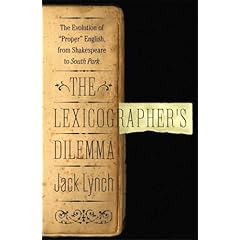
I just read a review of Jack Lynch's Lexicographer's Dilemma in the New York Times. Anyone familiar with things Johnsonian or with things 18th century has long known of Lynch through his fabulous website and his other important contributions to the field. I'm eager to read his book and figure out how much he's covered what I'd hoped to write about 18th century grammars.

Monday, December 14, 2009

Anything but my grading!

The peculiar rhythms of academic life do little but alienate us from our fellow human beings. A staff member in at our snack bar asked me earlier if I was ready for Christmas. Have I ever been ready for Christmas? Or have I been ready for Christmas since 1995? No, because I chose to spend my holiday preparations on wedding preparations!

Between grading, posting grades, and preparing for the MLA (which, mercifully, will be moving into January to ease the alienation), the whole holiday season gets short shrift. I can't even imagine how it is for friends and colleagues who celebrate Hanukkah, who must juggle holiday and final examinations. So I've decided that English faculty members round the world need to embrace Twelfth Night as their anchor point for the holiday season. Besides the clear Shakespearean references that can be exploited, Twelfth Night offers at least 14 days of free and clear holiday preparation after final grades are submitted. Moreover, academics (always in a state of genteel poverty--as one favorite graduate school professor described) could exploit "day after Christmas" sales to stretch their dollars. Integrate king's cake and wassail into the mix and we could have quite a festive holiday.

So friends, expect not Christmas cards from me. Oh no! If you get a card, it shall be a Twelfth Night card, mailed on January 2.

Thursday, December 3, 2009

As the Year Draws to a Close...

I can't help but think of all the things the early days of December signify to the academic:
  • The crushing regret of all the things that should have been said as the semester progressed that were left unsaid;
  • The horrific realization that half the things that one believed one said were said in years past;
  • The impossibility of a fully realized holiday season and promptly posted grades.
So for those of you who live in the limbo that is end of the fall semester, Happy Holidays, Happy Grading, and my condolences.

Monday, October 26, 2009

Looking for New Blends

I was reading a marvelous essay yesterday evening by the former Editor in Chief of the now-defunct Portfolio magazine, Joanne Lipman, on challenges to women in the workplace in the last ten years, largely after 9/11. Well, long story short: she brought up references to Hillary's "cankles." And it got me wondering about the cultural and historical conditions necessarily to facilitate blending. It's really a counter-intuitive process, really, and I can't help but wonder if there's some reason why there are so many blended terms showing up here and there.

The classic blend, of course, is "smog"--from "smoke" and "fog." And there's a nice logic to the equation. The two source words are both monosyllabic, both ending in a velar stop consonant. So they seem like a marriage made in, well, Los Angeles.

But what about "cankles." How logic defying? "Calf"--a monosyllable--meetd up with "ankle"--an unattractive double syllable--and somehow gives birth to "cankle," a word as displeasing as the supposed intersection of the two structures on one's lower extremity.

So are there new rules for blends? I'd love to come up with a catalog of these (in my copious spare time, of course) and see if the combinatory conditions that facilitate a blend have changed somehow in the last twenty years. Intuitively, I say "Yes." Of course, I've also learned that anecdotal evidence is the worst, so I'm looking for something testable here.

Friday, October 9, 2009

Has it been eight months?

It's so startling to think that it's been nearly eight months, by my poor mathematical reckoning, since I've written a blog post. Of course, such gaps call into question the necessity for the existence of the blog itself. So, in that spirit (and because I've been teaching about morphology), I've decided to write about the word 'blog.'

The well-known explanation of 'blog' that it represents a clipped form of the compound 'weblog.' In its original form, computer logs were simply collections of log-in data: who accessed files and when. When discussion boards went into web-based form, html recorded discussions started taking this log form, and then it spiraled out of control. Of course, this is seriously simplified version of the history of the 'blog.' A well-researched and documented explanation appears on a blog about blogs (which reminds me that I need to write about 'meta' as a verb form) provides a much longer and fuller picture of their history.

But my question is really about these personal blogs: public diaries that gain an audience. The blog has called into question the nature of new media (is unfiltered, unedited content truly authoritative--and should we long for authority anymore anyway) as well as the nature of privacy. Even if blogs really seem to be read by niche groups (one's Facebook friends and the like), what does it mean when we write something incendiary? If we don't intend harm, but harm happens anyway, what responsibility does the blogger have?

Now, I find it unlikely, as a comparatively private person who values the effect of the well-told narrative, that I would ever disclose such things. But what is my responsibility as a reader of blogs? If a blogger reveals too much, should I pretend the text doesn't exist, in the same way I ignore the existence of Twilight or bad Harlequin romance novels? Obviously, my attempt to ignore them has failed, since I can still name them. But perhaps their insertion into this discussion reveals something significant, from a psychoanalytic perspective. Perhaps one problem of the blog emerges from its original compound: as a "log," does a weblog create expectations of a particular kind in its readers.

Consider the OED definition for log, n 1, 7d: "Any record in which facts about the progress or performance of something are entered in the order in which they become known; e.g. (a) a record of what is found, or how some property varies, at successive depths in drilling a well; a graph or chart displaying this information; (b) a record kept by a lorry driver in which details of journeys are noted; (c) a record kept of what is broadcast by a radio or television station from moment to moment."

A log, as is clear from this definition, records objectively verifiable information. It tells, in an empirical sense, the truth.

But no matter our faith in a narrator, readers never expect a story about oneself to be entirely and completely true. As Bakhtin says, every hero is his own ideologue: he expresses his own truth, damn all the others. So perhaps the word 'blog,' having been clipped so unceremoniously from its original compound, has taken on a fictive connotation. The 'blog' is a new genre: extemporaneous, perhaps, but with a profoundly individualized subjectivity inseparable from the writer.


Friday, February 27, 2009

Startled to discover it's almost March

March always sneaks up on me. I've never really known if it was because February slips by so quickly, or whether March has some nefarious magic that makes it arrive more aggressively than all the other months of the year. While "April is the cruelest month" (my nod to T.S. Eliot) by far, March reminds us that all things pass and fade away.

March's name alone suggests the militaristic push forward, descended as it is from the Roman god Mars; but its homophony with the kind of march one is forced upon also strikes me as particularly cruel. When March first arrives, we're reminded that we're likely to be trampled under the feet of midterm examinations and papers, and that MLA submission deadlines are not far behind. We're also reminded that winter closes away and we need to begin preparations for our summer. For academics, this usually means that we have to figure out how we're supporting ourselves over the summer, since we're usually only paid 10 months of the year.

So as you prepare to turn in (or grade) those midterm papers, or clean out your closet of all the clothes you've outgrown this winter, just remember to "Beware the Ides of March." March 15 falls on Sunday this year.

Monday, September 29, 2008

Wacky Wordle

Wordle clouds have gone up on doors all over my department in the last few months, and I've longed for time to stuff a bit of Beowulf into the engine and see what happens. I was amazed to see that the engine generated a beautiful tree, albeit composed of graffiti-like characters. But the output seemed appropriately Germanic.